Keto Diet App - Free Download Keto Diet App - Free Download
Take the guesswork out of following a low-carb diet, lose body fat & feel great!
KetoDiet app is FREE to download!

The Pyramid Just Flipped
Why the New "Real Food" Guidelines Change Everything

★★★★★★★★★★
5 stars, average of 9 ratings

This post may contain affiliate links, see our disclaimer.

The Pyramid Just Flipped: Why the New "Real Food" Guidelines Change EverythingShareFollow us 261.1k

Quick Summary tl;dr

After 34 years of failed policy based on bad science and industry lobbying, the government has officially flipped the food pyramid.

Protein is King: Animal protein (steak, eggs) is now the "anchor" of the diet, with daily targets raised significantly to 1.2–1.6 g/kg, or 0.54-0.73 g/lb of body weight per day.

Fat is Back: Butter, tallow, and full-fat dairy are "in"; seed oils and processed carbs are "out."

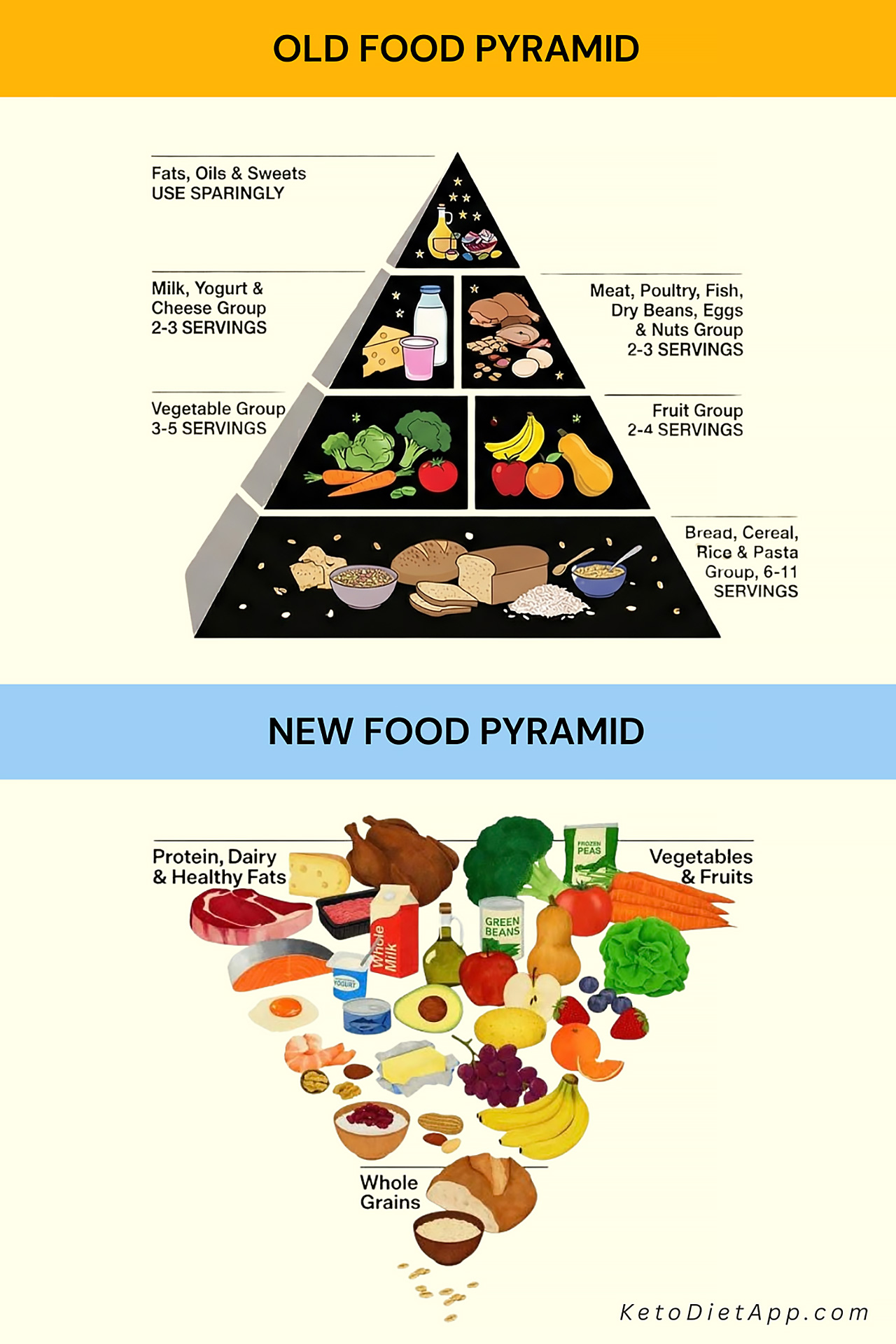
Grains Demoted: The "base" is gone. Grains are now the smallest category at the bottom (2-4 servings).

The Catch: While the food advice validates the low-carb lifestyle, the new alcohol rules are vague ("less is better" with no hard limits).

If you’ve been following the news, you know that something huge just happened. After 34 years of being told to load up on "heart-healthy" grains and fear the butter dish, the government has officially hit the reset button.

I had to squint at the new "Real Food" pyramid when I first saw it. Is that... steak at the top? And cheese? And are those grains hiding way down in the basement? This starts to look closer to a whole-foods based, low-carb food pyramid!

For years, we’ve been the "crazy" ones skipping the cereal aisle, and now it turns out the new government guidelines are basically just a low-carb cheat sheet. But before we do a victory lap, let’s talk about how we got here, why the old advice was such a disaster, and the few places where this new "Real Food" guide still gets a little messy.

Ending a 34-Year Failed Experiment

To understand why this is such a massive win, you have to look at what we are finally leaving behind. For over three decades (since 1992!), U.S. nutrition policy was built on a foundation of 6–11 servings of grains a day. Essentially, they told us to build our health on bread and pasta.

And the "science" behind that? It was shaky at best. It largely traces back to Ancel Keys and his "Seven Countries Study," where he famously cherry-picked data to blame saturated fat for heart disease (conveniently ignoring countries like France where people ate fat and lived long lives). (Yerushalmy et al, 1957)

We also know now that contrary results were buried—like the Minnesota Coronary Experiment ( Ramsden et al, 2016), which actually showed that swapping butter for vegetable oil increased death rates.

Add in some industry payoffs from sugar and vegetable oil companies ( Kearns et al, 2016). For example, the American Heart Association itself was launched into a national powerhouse in 1948 thanks to a massive donation from Procter & Gamble, the makers of Crisco ( Teicholz, 2023).

When you follow the money, you end up with a policy that preached "low-fat" while obesity rates skyrocketed. Basically, we’ve been part of a 34-year experiment that didn’t work.
The Pyramid Just Flipped: Why the New "Real Food" Guidelines Change EverythingPin itFollow us 148.4k

MyPlate vs. The New Pyramid

The previous model, MyPlate, was essentially the old pyramid flattened out. It still marginalized healthy fats and centered meals around grains and starchy vegetables.

The new 2026 guidelines have completely inverted that logic:

  • The Inversion: Grains have been demoted from the "base" to the very bottom tip of the pyramid (now just 2–4 servings).
  • Protein is the New Anchor: Protein recommendations have jumped significantly (aiming for 1.2–1.6 g/kg, or 0.54-0.73 g/lb of body weight per day), with a new focus on animal proteins like meat, eggs, and dairy as the "anchor" of the diet. This is close to what Drs. Stephen Phinney and Jeff Volek have always recommend!
  • Fat is Back: Full-fat dairy and animal fats (like butter and tallow) are back on the menu, acknowledging that natural fats are stable and nutrient-dense.

Excitement... With a Side of Caution

Is this a victory for real food? Absolutely. Seeing "Steak" and "Butter" near the top of a government chart is surreal. But we should stay grounded.

While the food recommendations are solid, other parts of the guidelines are a bit messy. For example, the new alcohol guidance has removed specific drink limits entirely, replacing them with vague "less is better" advice. When asked about it, officials gave confusing answers (suggesting the only rule is "don't drink it for breakfast"), which feels like a step backward in clarity.

The Verdict: The "low-fat, high-grain" era is officially over—at least in the U.S. Science is finally correcting course, but huge systems have massive inertia. It might take a while for the UK, Australia, and other nations to overcome that resistance and follow suit. But as always, we shouldn't wait for any government to tell us what makes us feel good. We've known for years that real food works—now, they’re just catching up.

Do you like this post? Share it with your friends! 

Martina Slajerova
Creator of KetoDietApp.com

Martina Slajerova

I changed the way I ate in 2011, when I was diagnosed with Hashimoto’s, an autoimmune disease that affects the thyroid. I had no energy, and I found it more and more difficult to maintain a healthy weight.

That’s when I decided to quit sugar, grains, and processed foods, and to start following a whole-foods-based ketogenic approach to food.

Leave a comment or review

Note: Any links to products or affiliate links will not be approved.
Please note that we do not offer personalised advice. For any diet related questions, please join our Facebook community.

Comments (11)

I didn't see this coming.... Everyone knows sugar and processed carbs are bad for us but this didn't seem to register for decades, especially when the money kept flowing. A huge win!

Mind blowing. I honestly never thought this would happen. My biggest worry is who brought this change... and whether it will last for that reason.

Also, alas, what the new pyramid DOESN’T do is state that sugar should be at the bottom, and then, SPARINGLY only.

Well spotted. I assume it's all group together as their goal is "encouraging a reduction in highly processed foods, carbohydrates, and sugars."

When I was first diagnosed as Diabetic 2 10 or 12 years ago I attended the Diabetes Clinic. I stopped going after a couple visits when I saw their recommended food pyramid, because I could not see that working at all.  I told my local clinic at the time it was all ass backward. I am in Canada. This what I found on Diabetes Canada site - Diabetes Canada doesn't use a traditional food pyramid anymore, but promotes the Plate Method, based on Canada's Food Guide, emphasizing half vegetables/fruit, a quarter whole grains, and a quarter protein to manage blood sugar.
I already receive your emails, so please don't double them up

You were definitely ahead of your time! It is great that you knew that 10+ years ago - so many people just followed the advice and got sicker, so good for you for listening to your gut (literally).
Regarding the Canadian guidelines: Yes, the 'Plate Method' is definitely an improvement over the old 1992 pyramid, but as you noted, it still reserves a quarter of the plate for grains/starches. For a diabetic, that can still be a huge amount of glucose to manage! That is why this new US update is so fascinating - it seems to be going even further than the Plate Method by actively prioritizing protein and fats and pushing grains to the absolute bottom. Hopefully, Health Canada takes notice and updates their advice soon too!
(And no worries on the emails - our system automatically filters duplicates, so you definitely won't get double messages! If you do, let me know as that would be a bug with our newsletter provider.)

Martina - very nice of you for taking the time to respond. It has been a while since anyone called me "ahead of my time" - HaHa! When I first began this journey the blog I followed was some doctor in the Netherlands - can;t recall his user name and he seems to have departed from blogging. Anyway, I follow you, Carolyn Ketchum (All I do is dream about food), but also enjoy Katrin - Sugar Free Londoner. Trying to read too many becomes overwhelming. So thank you - Dale

I totally get that! I don't follow anyone right now, I just don't have the time so I focus on news and research. There are so many people who no longer post/create new content, it's a pity but it is the reality mostly determined by Google. Fun fact: The ones you've mentioned are my good friends - Katrin lives not that far from me, and we meet for coffee every now and then 😊

Cool that you know Katrin. I think Carolyn (misplaced Canadian) is in Oregon. Pretty sure you would all be friends. I just recieved 5 emails so can you look from your end?

Carolyn is a lovely and talented lady. Could it be that you received a notification of your comment being approved/replied to? If it's anything else, it would be worrying. Thank you!

@ Dale: I completely agree with you on not being followers of the Diabetes Clinic or classes. When I was first diagnosed, they tried to send me to classes about how to eat, and they advocated for beans and lots of carb heavy foods!!! I went to 1 class, never went back. I also found Carolyn Ketchum via her book The Everyday Ketogenic Kitchen and now have all of her printed cookbooks in spiral. She and Martina are the only 2 keto blogs I follow, and I have mostly unsubscribed from all other bloggers I used to subscribe to due to their recipes being useless for me. Martina and Carolyn are the only 2 people who consistently share do-able recipes that don’t spike my blood sugar and are not complicated.
Thank you, Martina for the great work you do helping us who NEED keto for optimum health!
PS: I saw this when It first came out and it’s about time to get real about what foods are healthy!!!